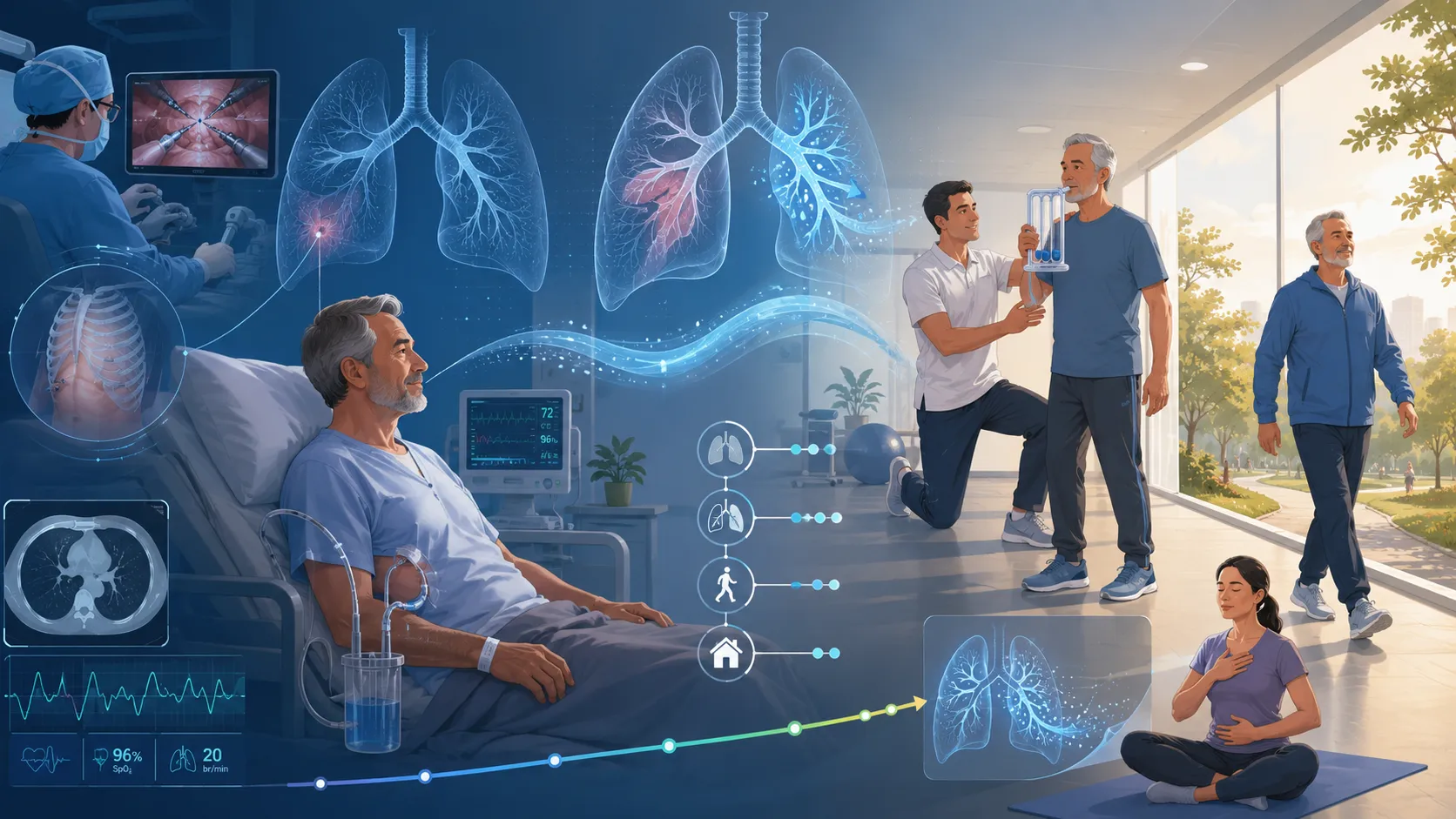
In suitable patients, surgery is the most beneficial option for bringing lung cancer under control. But, as much as the decision to operate, how recovery will go afterwards is among the things patients most want to know.
One of the questions patients often ask is: “How long will it take me to recover after the operation?”
The answer is usually individual. Recovery varies with the extent of the operation, the type of operation, whether it was done by an open or a keyhole method, the patient’s general health, lung capacity and other illnesses. For this reason the period after lung surgery does not go the same way in every patient and has to be assessed individually.
What is lung cancer surgery? How much of the lung is removed?
The aim of surgery in lung cancer is to remove the tissue containing the tumour “completely”, that is, leaving no tumour behind. The extent of the operation depends on the position, diameter and density of the tumour, its relationship to the surrounding tissue, the condition of the lymph nodes and the patient’s breathing and heart reserve. The most common operations are lobectomy (removal of one lobe of the lung), segmentectomy (removal of a more limited part) and pneumonectomy (removal of the whole lung on one side). The surrounding lymph nodes must always be removed at the same time.
What are the first days after surgery like?
The first few days after surgery are the period in which recovery is watched most closely. On the first day the patient is generally monitored in intensive care, and afterwards on the ward. Four hours after the operation, eating and drinking are started and the patient is helped to stand and move. The patient’s general condition is followed closely, and heart and breathing readings are monitored continuously, 24 hours a day, by a telemetry device throughout the stay.
After the operation the patient has a chest drain (a tube that allows air and fluid collecting in the area of the operation to be removed). The drain makes it possible to follow the re-expansion of the lung and any leakage of air, blood or fluid, and it is generally taken out within a few days.
During the same period pain is kept under control and the patient is encouraged to begin breathing exercises as early as possible. Respiratory physiotherapy is given. Early mobilisation (getting moving) is also an important part of recovery. Support is given with eating and with the return of normal bowel function.
How long does recovery take?
The average length of stay for our own patients is 4.2 days (one day in intensive care and three days on the ward). Recovery time is not fixed and depends on many factors. The extent of surgery, whether it was open surgery or a keyhole method (VATS, video-assisted thoracoscopic surgery, or RATS, robotic surgery), and the patient’s age, smoking history and other illnesses all have a direct effect.
In general, the hospital stay can range from a few days to a week. Most patients are able to return to daily activities within two weeks, while full recovery can take up to a few months in some patients.
Which complaints are most common after surgery?
Some complaints can occur in the period after surgery, and most of them are expected and temporary. Pain and numbness around the area of the operation are particularly common. They are caused by swelling and inflammation of the nerves that run between the ribs and are temporary. In some patients the swelling and inflammation of the nerve can last a long time and the pain can be severe; this is called intercostal neuralgia, and support from pain specialists or neurologists may be needed.
Breathing capacity is measured by tests before the operation, and the capacity that will remain afterwards is calculated. If the lung capacity that would remain is not sufficient, surgery is not planned.
After the operation you may feel unable to take a full breath, or be breathless on exertion. Much of this arises while the lung is adjusting to its new state. As lung capacity adapts over time, these complaints generally ease.
Why are breathing exercises and respiratory physiotherapy important?
Breathing exercises are one of the most important parts of recovery after lung surgery. They help the lung to work effectively again and reduce the risk of complications after surgery. They are especially useful in reducing the risk of collapse of part of the lung (atelectasis, when not enough air reaches part of the lung) and of infection. For this reason, respiratory physiotherapy is recommended early after surgery and needs to be done regularly. In our own patients we begin respiratory physiotherapy before the operation and continue it until discharge, and indeed after discharge as well.
What does follow-up after surgery involve?
Follow-up after surgery is an integral part of treatment. During this period patients are seen at set intervals, and both their general condition and the course of the disease, including any recurrence or spread, are assessed. The intervals depend on the stage of the tumour. For stage 1 tumours, patients are called for a check every six months for the first five years and once a year after that. For other stages, checks are every three months for the first two years, every six months between years three and five, and once a year after five years.
At each visit the patient is asked about any complaints, a physical examination is carried out and a CT scan of the chest is taken. Where needed, a PET-CT scan or a contrast-enhanced MRI of the brain is requested. The follow-up plan is tailored to the individual according to the stage of the disease, the extent of the operation, any additional treatment received before or after surgery (chemotherapy, immunotherapy or radiotherapy) and other illnesses.
When might additional treatment be needed?
Each patient’s treatment is planned for that patient. In some patients surgery alone is enough, while in others chemotherapy, immunotherapy or radiotherapy may be recommended, depending on the features of the tumour.
These treatments may be considered in particular where the lymph nodes are found to be involved or the disease is at a more advanced stage. The decision is generally made by a multidisciplinary team, individually for each patient.
What should you pay attention to after surgery?
For recovery to progress well, some basic points need attention. Stopping smoking for good, doing breathing exercises regularly, walking every day, eating well, staying away from crowded and enclosed places, particularly in the early period, sleeping regularly and keeping your follow-up appointments are the most important parts of this period.
In addition, if something unexpected happens, such as sudden breathlessness, fever, blood in the phlegm or severe pain, you should contact a doctor without delay.
Does every patient go through the same process?
Recovery after lung surgery differs from patient to patient. Some patients recover in a shorter time, while in others recovery can take longer.
The difference depends on the patient’s general health, the type and extent of surgery, lung reserve (the functional capacity of the lung), the heart and other illnesses. Recovery should therefore always be assessed individually.
How should the period after lung surgery be approached?
The period after lung cancer surgery calls for patience and regular follow-up. Some of the complaints that arise are usually temporary and tend to ease with time.
What matters is to understand the process properly, follow your doctor’s advice and not miss your check-ups. Unnecessary anxiety should be avoided; but careful monitoring after surgery is equally important.
With appropriate follow-up and support, many patients are able to return to their daily lives within 15 days. What makes the difference is individual planning and regular clinical assessment.
You can follow us on Facebook, Instagram and YouTube.
This article is for general information only and does not replace an individual medical assessment.